The Cord of Life: A Story Woven Through Time
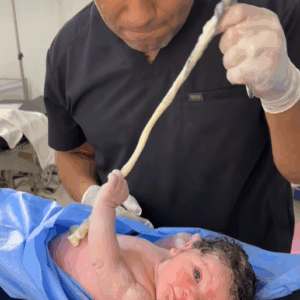
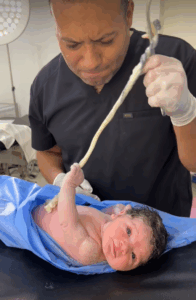
In a brightly lit room deep within a modern hospital, a moment unfolded that mirrored echoes from the dawn of humanity. A newborn, swaddled in blue linen, lay wide-eyed on the delivery table, her tiny hand gripping tightly to her umbilical cord—her first act of defiance, of instinct, of connection. The doctor, caught in a brief expression of awe and disbelief, held the other end of the cord, as if suspended in time by the profound symbolism of what was happening.
This was more than a medical event. This was a living monument to thousands of years of human birth, survival, and mystery. That cord, pale and twisting, once the lifeline between mother and child, had become a symbol of everything that connects us—not just to our mothers, but to all of humanity.
From Womb to World: The First Thread
Since prehistoric times, the umbilical cord has been a silent witness to the very beginning of human life. Long before hospitals and sterile gloves, children were born under open skies, in caves, huts, temples. The first midwives were grandmothers and tribal women, guided by knowledge passed through generations like fire from one hand to the next.
In ancient Mesopotamia, birth was both a miracle and a mystery. The Sumerians believed the umbilical cord carried the essence of life from the gods themselves. Archaeologists have unearthed clay tablets with markings describing rituals of cutting the cord—a sacred moment believed to determine the fate of the child. To sever the cord was not just to separate mother and child, but to invite the soul fully into the world of the living.
Egyptian papyri tell us that cords were often buried with reverence, wrapped in linen and placed near the child’s sleeping mat. In some African cultures, the cord was kept and later planted under a tree to symbolize the child’s growth. Among the Navajo, the cord might be buried in a special place, like a sheep corral, so the child would remain close to their homeland. Every culture saw in this fragile strand a thread tying the newborn not only to their mother—but to the earth, to community, and to the cosmos.
The Archeology of Birth
Imagine a team of archaeologists digging in a long-forgotten village. They uncover a burial site—a woman and child, their bones undisturbed. Between them lies a calcified remnant of a cord. Such discoveries are rare but profound. They force us to confront a reality we often overlook: birth is as ancient as death, and just as sacred.
In the highlands of Peru, mummified infants have been found with umbilical cords still intact, preserved in the dry Andean air. In Neolithic tombs in Europe, small stones arranged in circles near infant remains are believed by some to mark birthing rituals or protective charms laid over the umbilical area. These traces reveal a truth: every time a baby was born, the world held its breath.
We marvel at pyramids, at temples, at weapons of war—yet what artifact could be more universal than a baby’s first cry and the simple thread that sustained them?
Back to the Room: A Moment of Infinite Meaning
The photo brings us back. A newborn, not crying but staring—deep blue eyes fixed on the world for the first time. Her fist clenched around the cord as if refusing to let go of the warmth, the pulse, the rhythm that had been her only world for nine long months. The doctor watches, not as a technician but as a witness, perhaps reminded of his own child’s birth, or of something much older.
In this single frame, so much is captured. Vulnerability and strength. Past and future. Science and miracle. The child’s grip is a message written in a language older than words: I am here. I came through. I remember where I came from.
It’s easy to forget, in the age of monitors and machines, how primal birth remains. Underneath the beeping and bright lights, the ritual persists. The breath, the blood, the waiting. And then—arrival.
The Emotional Memory of Humanity
There’s a theory among some anthropologists that human memory is not just stored in the brain, but in gestures, in instincts. The newborn holding her umbilical cord might be reliving the memory of the womb—where every movement, every heartbeat, every kick was felt through that very connection.
Even now, many mothers keep their children’s umbilical stump as a token, dried and wrapped, tucked into boxes beside baby teeth and locks of hair. Some cultures still burn it, or tie it into protective charms. We may have forgotten the ceremonies, but not the sentiment.
What do we truly let go of when the cord is cut? Just the body—or also something more ancient, something we might spend the rest of our lives seeking again? Safety, belonging, a pure sense of being held?
The Future Beneath Our Feet
As medical science advances, researchers have begun storing stem cells from umbilical cords, unlocking regenerative medicine and treatment for previously incurable conditions. The same cord that once gave life might one day help save it again—centuries after the first midwives whispered blessings into the morning air.
Perhaps the baby in this image will live to see a world where those cells rebuild organs, cure blindness, or reverse disease. She won’t remember the moment she clutched that cord—but the photo will remain, a fossilized heartbeat captured in pixels.
And when she’s older, maybe someone will show her the image and say: “This was your first instinct. To hold on.”
A Thread That Never Ends
There’s a kind of poetry in the fact that we all begin connected. No matter where we are born—desert or city, palace or refugee camp—we all take our first breath after the same gesture: the cutting of the cord.
This photo does more than show a birth. It holds a mirror to our humanity. To our shared beginnings. It reminds us that we are all, quite literally, cut from the same cloth.
And maybe, in a world so eager to divide, we need more reminders of what first connected us.