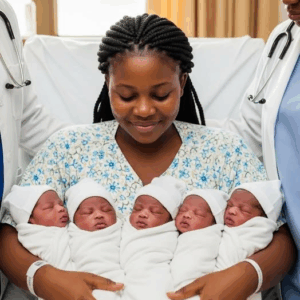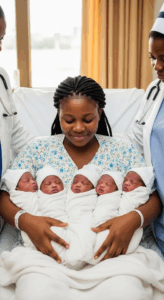
In a quiet hospital room bathed in warm morning light, surrounded by attentive nurses and the gentle hum of machines, a young mother sits cradling not one, but five newborn miracles. Her smile is soft but radiant, her eyes closed in a moment of reverence—perhaps for the magnitude of what she has just done. Each of the infants, wrapped snugly in white like swaddled stars, rests peacefully against her, unaware that their arrival has already become a story whispered in awe through the hospital corridors and soon, the world.
Her name is Amara. A name that means “grace” in many tongues, and never has it felt more fitting. In her arms are the quiet answers to the silent hopes of generations—hopes passed from matriarchs to daughters, whispered into bowls of millet, prayed over beneath moonlight, and carried through hardship and history. Five children born in a single breath of time. Not royalty, not prophecy, but something rarer: a living echo of life’s insistence on continuing.
Science has a name for this—quintuplets. A statistical improbability. Doctors speak of ovulation, zygotes, and chromosomes. But the heart tells a different tale. It recalls ancient legends of birth-goddesses and fertile fields, of tribal songs sung around fires where elders foretold futures based on omens like this. In earlier centuries, such a birth might have sparked festivals or fear. In some cultures, it would be seen as a divine sign—blessing or burden, depending on the worldview. Now, in the age of sanitized wards and neonatal teams, it’s a headline. But for Amara, it is simply love, multiplied.
The journey to this moment was anything but simple.
For months, she carried the weight of not just her own life, but five tiny heartbeats fluttering beneath her skin like caged birds. She endured sleepless nights where her body ached, unsure of how to stretch far enough to contain so much life. There were ultrasounds that showed wriggling limbs dancing in shared silence, and there were fears—the very real ones, of premature birth, of complications, of not being enough. But Amara never flinched. She walked softly, ate carefully, and whispered stories to the children growing inside her.
The hospital staff had prepared extensively. Specialists were flown in. Incubators stood waiting. And when the time came—under the silver glare of surgical lights, with masked faces gathered around like witnesses to a sacred ritual—she brought them into the world one by one. Five tiny wails, five pairs of fists, five sets of lungs gasping at their first taste of breath. Five lives, forever intertwined, delivered through one woman’s strength.
And now, here they are, nestled like petals against her chest.
The nurses stand nearby in quiet celebration. They have seen miracles before, but few like this. One adjusts a blanket, another wipes away a tear she doesn’t try to hide. This is the kind of day they train for—the kind that reminds them why they chose this calling. The moment is more than medical; it is myth reborn.
There’s something timeless about a mother and her newborn. Archaeologists have unearthed clay figurines from ancient Mesopotamia—fertility goddesses with swollen bellies, symbols of life’s enduring mystery. In medieval manuscripts, midwives were portrayed as saints, guardians at the threshold between life and death. Even in the oldest burial sites, children are often found curled beside their mothers in eternal embrace. Across cultures and centuries, this bond is constant.
And yet, here, now, in this modest room overlooking a city too busy to notice what just happened, history repeats itself in flesh and heartbeat.
What awaits these five children?
They are born into a world of contradiction—both connected and fractured, brilliant and burning. They will grow in an age of technology their ancestors couldn’t have dreamed, yet still hunger for the same things: love, belonging, the story of where they come from. They may carry echoes of each other in thought and gesture, finish one another’s sentences, or walk vastly different paths. But their roots are the same. Five seeds, one garden.
And Amara? She is no longer just a woman. She is a monument. Not the kind built of stone, but the kind carved by time into memory. Years from now, people will ask her what it was like. How did it feel? Was she afraid? She will smile, perhaps a little tired, perhaps a little proud. And she will say the truth:
“It was hard. And it was beautiful. And I would do it all again.”
Because in a world that often forgets to marvel at the ordinary, this is extraordinary. A quiet, uncelebrated miracle. Not in temples or cathedrals, but in a hospital bed, in the arms of a woman who dared to carry five stars inside her.
And when the story is told, let it be told like this—not just in numbers or medical terms, but in poetry. In reverence. In wonder.
Because some days, history is not written in stone.
It is born.