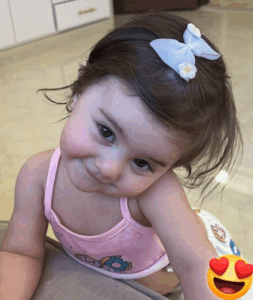
It was not a ruin buried beneath layers of ash, nor a statue crumbling with age that drew my attention that day—it was her. A child with eyes the color of ancient olive groves and a tilt of the head so effortlessly gentle, it could bend the will of history itself. In the center of a sunlit marble room, with the golden light scattering across polished stone like flakes of forgotten treasure, she stood—not as a relic of the past, but as a whisper of what all those ruins had once been built to protect: joy.
She was perhaps two years old, though time seemed unwilling to impose its full presence on her. Her hair, as dark as ink pressed into papyrus, swept across her forehead like the winds that once carried desert caravans toward forgotten cities. Fastened near her temple, a white ribbon held two dainty daisies—a crown simpler than Cleopatra’s but worn with equal sovereignty. Her cheeks, flushed with a tender pink, reminded me not of royalty, but of humanity’s oldest murals where mothers once painted their children onto cave walls—not to immortalize them in power, but in love.
Her shirt bore playful cartoons, yet the weight of her presence surpassed the trivial. It felt like I was witnessing a reincarnation of something far older than childhood—a kind of eternal light that temples, scrolls, and prayers across centuries have tried to capture. I had spent my life digging through the bones of empires, brushing sand from stone lips that could no longer speak. But here, in this little girl’s half-smile, there was more language than any ancient tongue could offer.
I was reminded of Çatalhöyük, one of the oldest human settlements ever unearthed in Turkey. There, archaeologists found shrines filled with bull skulls and mother goddess figurines—symbols of strength, fertility, continuity. And though the figurines were crafted in clay, they bore expressions almost as soft as hers. For thousands of years, long before cities were even imagined, humanity placed its hopes not in conquest, but in the promise of children. This child, with her hands gripping the edge of a cushioned seat, was that same promise reborn: fragile yet indestructible.
It made me think of another girl, one lost to time—her skeleton found curled in a volcanic bed in Pompeii, clutching a wooden doll, her final gesture one of imagined play as Vesuvius buried her world. I had seen her remains once, behind glass, treated with reverence. But seeing this living child, warm and curious and real, I understood for the first time what was truly buried that day—not just people, but potential, laughter, the tilt of a head paired with mischief in the eyes.
You see, archaeology isn’t just about what we dig up; it’s about what we try to recover in ourselves. And in that moment, watching this little girl lean forward with a grin not yet dulled by caution, I remembered why we search. Not for gold or glory, but for moments like these. Moments that outlast stone, that defy language, that speak to something deeper than history—the sacred rhythm of being alive.
A voice called from off-frame—a mother’s voice, perhaps—and she turned slightly, just enough to let the light catch in her eyes. They sparkled not with knowledge, but with wonder. It is that wonder that built the ziggurats of Ur, that lit the first fires of story in Neolithic caves, that compelled sailors to chase the horizon even when the sea threatened to swallow them whole.
In her presence, I didn’t see the future. I saw the continuity of the human spirit, older than pyramids and more enduring than empire. We often say children are the future, but I believe they are something more—they are time’s reset button, proof that no matter how fractured our world becomes, something innocent and bold still rises from the dust.
One day, she will ask about the world. About the ruins and wars, the poems and paintings, the old cities I spent decades trying to understand. And I hope someone will tell her not just the facts, but the feelings. That once, there was a moment in a sun-drenched room where a man who had studied the past his whole life felt humbled not by kings or gods—but by a child’s smile. That in her, I saw the only monument that truly matters.
What did the ancients hope for when they built their temples? What did they pray for in stone amphorae and etched prayers? Maybe it was this: a future where laughter returned to hallways, where small hands reached out not to rule, but to touch, to love, to belong. Maybe they built for her.
So no, this isn’t an archaeological discovery. It isn’t a relic or a theory. But to me, it is everything history ever tried to capture: a single, perfect moment of life.
And isn’t that the rarest find of all?