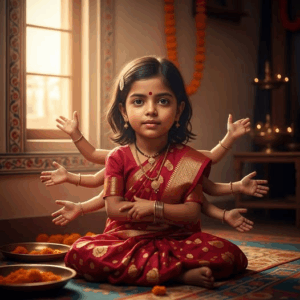
In a quiet village nestled between the ancient ghats of southern India, where the scent of marigold and sandalwood lingered in the air and temple bells chimed at dawn and dusk, an astonishing discovery sent ripples through both the archaeological and spiritual communities. It was not unearthed beneath the soil, nor found within the crumbling pages of a manuscript—but in the warm, serene presence of a little girl seated on a silk mat in a sunlit temple room. Dressed in deep red silk woven with golden motifs, she bore a calm, almost divine expression. Her tiny hands were folded in a gesture of peace—yet what stunned every onlooker, from villagers to visiting researchers, was that she had not two, but eight perfectly formed arms radiating from her sides.
At first glance, she seemed like a living embodiment of Durga, the warrior goddess often depicted with multiple arms. To the devout, it was nothing short of a miracle, a divine reincarnation made flesh. But to the historians and archaeologists summoned from Delhi and beyond, this image opened a labyrinth of questions—not about the child’s anatomy, which closer inspection revealed to be an illusion crafted with remarkable ingenuity—but about the history and meaning embedded in this tableau.
The illusion had been masterfully constructed: false arms, sculpted from ancient painted wood and adorned with real gold bangles, attached via silk-wrapped frames to her back. Every detail—from the posture of each hand to the symmetrical precision of the setup—echoed iconography found in temple carvings dating back to the Chola dynasty, over a thousand years ago. The room she sat in had once served as a private shrine, its walls lined with faded frescoes and geometric patterns in the traditional kalamkari style. But this was no ordinary performance for tourists or a mere cultural reenactment. It was a living tradition, preserved by one family for generations and only revealed during the festival of Navaratri.
According to the village elders, the child belonged to the direct bloodline of temple dancers and spiritual caretakers—women who, for centuries, had served as the human interface between deity and devotee. These women, known as Devadasis, once held respected positions in the religious and artistic life of southern India. However, following centuries of colonial misinterpretation and legal bans, their roles faded into obscurity, replaced with stigma and misunderstanding. Yet, in this village untouched by time, some fragments of that tradition endured, passed down like secret hymns whispered into the ears of sleeping children.
The girl’s name was Kaveri, named after the sacred river. She was only six years old when she first took her place in the ancestral chamber—her eyes wide not with fear, but with a serene awareness far beyond her years. Her grandmother, herself a last vestige of the Devadasi order, had trained her in ancient gestures, chants, and the subtle meanings of mudras—hand signs that conveyed entire narratives from epic tales. But it was during an annual ritual known as Alankara Puja—the adornment of the deity—that Kaveri was transformed not into an idol, but into the vessel through which the goddess herself was believed to appear.
For archaeologists like Dr. Priya Rao, who had spent her career excavating sunken temples along the Kaveri Delta, the discovery of Kaveri stirred something deeper than professional curiosity. She remembered standing before bronze statues of multi-armed deities housed in cold museum galleries—silent, still, and stripped of context. Now, before her, was not bronze, but blood and breath, history revived not through excavation but through living memory.
As the research deepened, old manuscripts were brought forth—palm-leaf scrolls from the temple’s archives, their grantha script still legible. They spoke of rituals in which young girls were temporarily imbued with the identity of a goddess, a symbolic merging of the mortal and divine, designed to reinforce harmony between the earthly realm and the spiritual. These scrolls mentioned elaborate costumes, precise choreography, and even the crafting of multiple arms to emulate the power and protection offered by deities such as Durga or Kali. This was no fantasy—it was historical performance, now nearly forgotten, cloaked in the whispers of myth.
But even more poignant than the ritual was what it revealed about how the ancients perceived the divine. Unlike modern divisions between faith and reason, between performance and belief, ancient Indian thought embraced the idea that divinity could momentarily inhabit the human form. The act was not considered deception but a sacred collaboration between community, tradition, and the cosmos. The girl was not pretending to be the goddess—she was the goddess, if only for a moment.
For Kaveri’s parents, both of whom worked as caretakers of the temple grounds, the ritual was not about fame or spectacle. It was about continuity, the passing down of identity in a world rapidly forgetting its roots. In a time where screens had replaced stories and temples had become monuments rather than sanctuaries, this single act stood defiant—reminding both the learned and the faithful that the past was not dead, merely sleeping.
Dr. Rao would later publish a paper on this discovery—not a scientific study per se, but a narrative essay blending anthropology, personal reflection, and historical insight. She titled it The Goddess in the Child, and it quickly became a touchstone in discussions of intangible cultural heritage. Yet what moved readers most wasn’t the cleverness of the ritual, but the look in Kaveri’s eyes—a gaze that seemed to stretch across centuries, speaking both of innocence and immense spiritual responsibility.
In the end, the illusion of the eight arms wasn’t what held the world’s attention. It was the reminder that in the heart of one small girl lived the echoes of an ancient civilization—one that saw no separation between the sacred and the human, between history and myth. And in that quiet temple room, with marigolds scattered on the floor and oil lamps flickering in shadowed corners, the past had come alive—not in ruins or relics, but in the spirit of a child who had once, if only for a festival, become a goddess.