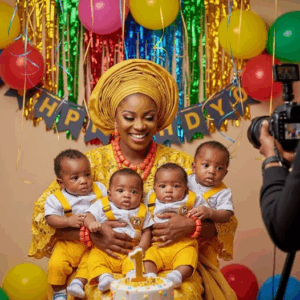
In a sunlit room blooming with color and laughter, where balloons danced on strings and golden letters spelled out “HAPPY BIRTHDAY,” a mother sat resplendent in a traditional golden gele and lace dress. Her smile radiated not just happiness, but triumph, pride, and an overwhelming sense of gratitude. In her arms rested not one, but four identical bundles of life—her quadruplets, celebrating their very first birthday.
Their clothes were perfectly coordinated: white shirts tucked into mustard-yellow overalls, each adorned with the number “1.” A cake topped with a bold numeral stood before them, a sugary beacon of this milestone moment. It was a scene bursting with color, culture, and quiet wonder, captured through the lens of a camera—but it was more than just a birthday celebration. It was a celebration of survival, of faith, of womanhood, and legacy.
This mother, known in her community as Ijeoma, came from a lineage of strong Nigerian women whose stories were etched in both hardship and resilience. In the ancient towns of southeastern Nigeria, stories are told of women who carried not just children, but the future of their clans. To bear twins was once seen as a mystical omen—both feared and revered. But to give birth to quadruplets? That was a tale from legend, the kind passed on in village moonlight with wide eyes and reverent voices.
Modern medicine made their birth possible, but it was Ijeoma’s unwavering courage that carried them into the world. From the day she discovered she was expecting four lives instead of one, she became a vessel of both anticipation and fear. Each check-up, each sleepless night, every contraction and every quiet prayer, built the mosaic of this moment. Her mother, who had never held more than one baby at a time, would often tell her: “You are living what our ancestors only dreamed of.”
In the months after their birth, Ijeoma’s days blended into a rhythm of bottles, lullabies, and late-night lull. But this first birthday was not just an anniversary—it was a victory lap. Behind the confetti and camera flashes stood a year of transformation. She had become more than a mother. She was now a living legend in her neighborhood, a symbol of abundance and blessing. People from nearby towns would visit just to catch a glimpse of her with the four, whispering old proverbs about fertility and grace.
Archaeologists once uncovered sculptures in Nok terracotta that showed women surrounded by children, their arms strong and welcoming. For a long time, scholars debated whether these were symbols of literal motherhood or metaphors of nurturing communities. But one look at Ijeoma with her four radiant boys silenced that debate. She was both: a mother, and a nurturer of the future.
In this image—this joyful, vibrant freeze-frame—history and humanity meet. It’s not just about four babies turning one; it’s about a mother carrying forward generations of strength, wrapped in fabric, woven with love, and stitched in celebration. It is the kind of story that no museum can contain, no textbook can define. It lives in the heartbeats of these four brothers, and in the enduring smile of the woman who gave them life.